How AI Is Changing Product Recommendations for Indian E-commerce Brands

For years, Indian online stores relied on a fairly simple logic: show the bestsellers, promote what is on discount, and hope the customer finds something they want. That approach worked when choice was limited and when shoppers had fewer places to buy. Today, neither of those conditions holds. Indian consumers have more options than ever, and the brands that earn repeat purchases are the ones that feel personal.
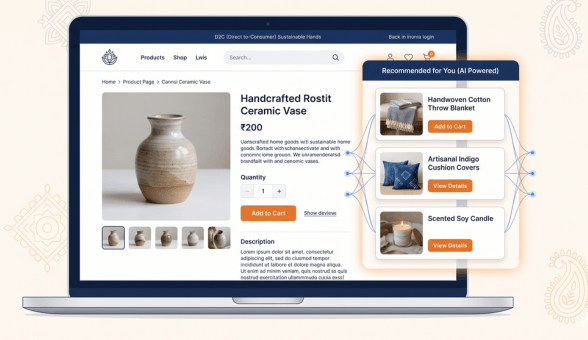
This shift is where artificial intelligence is playing a quiet but decisive role. AI-powered product recommendation engines are no longer reserved for giants like Amazon or Flipkart. Platforms built for Indian D2C sellers are now making this technology accessible, and the results in conversion rates and average order values are hard to ignore.
Why Generic Recommendations No Longer Work
The traditional approach to recommendations, usually a static “Customers Also Bought” section populated by overall sales data, treats every visitor the same. A first-time buyer browsing organic grocery products gets the same suggestions as a loyal customer who has purchased fifteen times. There is no nuance, no memory, and no real intelligence behind it.
Indian shoppers have grown increasingly selective. With mobile-first behaviour, shorter attention spans, and the ability to compare prices across platforms within seconds, a poorly timed or irrelevant recommendation is not just ignored. It quietly drives someone to a competitor.
AI recommendation engines solve this by looking at individual behaviour, not just aggregate data. What pages a visitor spent time on, what they searched for, what they added to cart and then removed, what category they gravitate toward on return visits. All of this feeds into a model that learns over time and improves with every interaction.
Want smarter recommendations for your store?
What AI Recommendation Engines Actually Do
Understanding what the technology does under the hood helps demystify it. Most modern recommendation systems used in e-commerce operate across a few core approaches.
| Recommendation Type | How It Works | Best Used For |
| Collaborative Filtering | Matches shoppers with similar purchase patterns | Cross-sell, bundle suggestions |
| Content-Based Filtering | Analyses product attributes like category and material | New visitor journeys |
| Hybrid Models | Combines both methods with real-time behaviour signals | High-intent returning buyers |
Collaborative filtering is particularly effective for Indian markets because purchase patterns within communities and demographics tend to cluster meaningfully. A buyer from a tier-2 city shopping in the festive season shows entirely different signals than a metro-based buyer shopping on a weekday afternoon. A well-trained model captures these patterns without the brand needing to manually segment or create rules.
The Conversion Impact on Indian D2C Brands
Brands that have adopted AI-driven recommendations consistently report improvements in two critical metrics: conversion rate and average order value. The personalisation creates a context where the shopper does not have to work hard to find what they might want next. The store, in effect, curates itself for each visitor.
For Indian brands dealing with high cart abandonment, intelligent recommendations placed at the right moment during the checkout flow can recover purchases that would otherwise be lost. A well-timed “you might also need” prompt on the cart page converts browsers into buyers at a fraction of the cost of a retargeting ad campaign.
Boomimart’s commerce platform supports product recommendation features as part of its broader suite for Indian online sellers. When you are building a store that needs to compete beyond price, tools like these give you a genuine edge. You can explore more about the platform’s capabilities at
Building a Recommendation Strategy That Fits Indian Buyers
Technology alone does not close the loop. Indian e-commerce has some nuances that global platforms often miss, and a recommendation strategy needs to account for them.
Regional language preferences matter. A buyer browsing a South Indian grocery brand who receives suggestions with product names in their own language is far more likely to engage. AI models that can account for regional catalogue variations offer a significant advantage here.
Festive seasonality is another layer that Indian brands must handle thoughtfully. Recommendations that make sense in October during Diwali are often irrelevant in June. A smart engine adjusts the weighting of seasonal products dynamically, so your homepage does not look stuck in the wrong season.
Finally, price sensitivity varies dramatically across India’s diverse buyer segments. An effective recommendation system does not just suggest the most expensive complementary product. It factors in price range awareness and is more likely to suggest an upgrade or bundle within a bracket that the buyer has already shown comfort with.
| Buyer Signal | What It Indicates | Ideal Recommendation Action |
| Repeat category visits | High interest, low decision | Feature a review-rich product in that category |
| Cart addition without checkout | Price hesitation or distraction | Suggest a similar item at a lower price point |
| High session time on single product | Consideration stage | Show bundle or complementary product |
Where Recommendations Should Live in Your Store
Placement is as important as the quality of the suggestion itself. Most Indian D2C brands underutilise the real estate available to them for recommendations. The homepage typically gets the most attention, but that is where recommendations are often the least personalised because you know the least about the visitor at that point.
Product pages and post-add-to-cart moments are where AI recommendations deliver the highest return. At these points, you have already captured intent. The buyer has shown you what category and price range they are interested in. A well-placed recommendation here does not feel intrusive. It feels helpful.
Post-purchase emails are another underused channel. AI systems that connect across your store and your communication stack can trigger personalised follow-up suggestions based on what was just purchased. Research on e-commerce personalisation patterns, including work published by
Want smarter recommendations for your store?
Common Mistakes Indian Sellers Make with AI Recommendations
Many sellers enable recommendation features and then leave them running without reviewing performance. The assumption that AI will handle everything without oversight is one of the more expensive mistakes in D2C commerce. Recommendation engines need good data to work well, and in the early days of a store, data is sparse.
- Showing recommendations before you have enough purchase history leads to generic output that does not add value
- Not separating recommendation logic for mobile visitors versus desktop visitors, even though Indian mobile buying behaviour is distinctly different
- Ignoring the impact of poor product titles and descriptions on content-based filtering, which relies on catalogue quality
- Treating recommendations as a set-and-forget feature rather than an ongoing optimisation task
What to Look for in a Platform That Supports AI Recommendations
For an Indian D2C brand evaluating whether their current platform supports meaningful AI-driven personalisation, a few questions are worth asking. Does the platform allow you to configure recommendation placement independently across different pages? Does it provide visibility into what is being recommended and why? Can it connect to your email or WhatsApp marketing stack to carry personalisation beyond the website?
A platform like Boomimart is built with Indian sellers in mind, and product recommendation functionality is part of a broader commerce ecosystem that includes inventory management, order processing, and customer communication in one place. For brands serious about scaling beyond a transactional store into one that builds relationships, this integration matters more than any single feature.
Businesses that have moved their stores to Boomimart have noted the difference in how the platform thinks about the full commerce journey and not just the checkout moment. You can get a closer look at how it fits your business through the demo available at
The Indian e-commerce landscape is moving toward a point where personalisation is not a differentiator but a baseline expectation. Brands that build this into their foundation now, rather than treating it as a future upgrade, are the ones that will hold customer loyalty when the next wave of competition arrives.