How to Start Selling on Your Own Website Instead of Amazon or Flipkart

Most Indian sellers start on Amazon or Flipkart because it is the fastest way to get in front of buyers. There is no website to build, no payment gateway to configure, and orders start coming in within days. But once the volume grows, a familiar pattern shows up on every settlement report: commission, fixed fee, shipping deduction, collection charge, and GST on all of it, quietly eating into a margin that looked healthy on paper.
At some point, sellers start asking a different question. Instead of how do I sell more on the marketplace, it becomes why am I not selling on my own. Here is what that move actually involves, and what you should have in place before you make it.
Why Sellers Outgrow Marketplaces
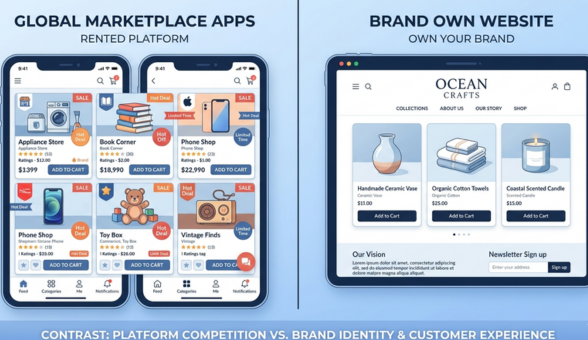
Marketplaces are excellent at distribution and terrible at giving you ownership. You do not own the customer relationship, since the buyer is the marketplace’s customer first. You cannot run your own retention campaigns without restrictions, you compete on the same page as five other sellers selling a similar product, and your pricing power is constantly squeezed by whoever is willing to undercut you that week.
None of this makes marketplaces bad. It makes them a channel, not a business. A brand selling only through Amazon or Flipkart is renting its customer base every single day.
What You Give Up on a Marketplace
| Aspect | Marketplace | Own Website |
| Customer data | Limited or none | Fully yours |
| Branding | Same template as competitors | Fully customised |
| Fees | Commission per order | Fixed platform cost |
| Repeat marketing | Restricted | Email, WhatsApp, SMS, your choice |
According to Flipkart’s official fee structure, commission rates alone can run anywhere from a few percent to well over twenty percent depending on the category, before fixed fees, shipping and collection charges are even added.
Flipkart publishes its current commission and fee structure here, and it is worth checking against your own category before deciding how much margin a marketplace listing actually leaves you.
The Real Cost Comparison
Marketplace fees scale with every single sale, which means your cost grows forever as you grow. A website platform cost is usually fixed or tiered, which means the more you sell, the smaller that cost becomes as a percentage of revenue. The break-even point depends on your category and order volume, but most sellers doing a meaningful number of monthly orders find that an own website becomes cheaper within a few months, not years.
| Cost Type | How It Behaves |
| Marketplace commission | Percentage of every sale, forever |
| Own website subscription | Fixed or tiered, predictable monthly cost |
| Payment gateway charges | Similar on both, usually 1.5 to 2 percent |
| Marketing cost | Higher initially on own site, lower long term |
What You Need Before You Move
Selling on your own website is not just putting up a storefront and waiting. You need a payment gateway that supports UPI, cards and COD, a logistics partner or integration for shipping, a GST compliant billing setup, and a way to bring traffic to a domain that nobody is searching for yet. This last part is what trips up most first-time movers, since marketplace traffic is built in and website traffic is not.
The good news is that an existing marketplace presence solves part of this problem. You already have product photos, descriptions, reviews and a sense of what sells. Moving that catalogue to your own platform is largely a transfer job rather than a rebuild.
Making the Transition Without Losing Sales
Run both channels in parallel rather than switching overnight. Keep your marketplace listings live while your own website builds traffic and trust, and use marketplace orders to nudge repeat buyers toward your website with a discount code or a loyalty offer on the packaging insert. Over time, a growing share of repeat customers shifts to ordering directly, since you now have their email or WhatsApp number and can talk to them without paying a platform for the privilege.
Picking the right platform for this matters as much as the decision itself. A platform built for Indian payment methods, GST and regional logistics partners saves months of integration work compared to stitching together a generic website builder with separate plugins for each requirement.
Is It Worth It for a Smaller Seller
Even sellers doing a modest number of orders a month benefit from having a website, even if the marketplace remains their primary channel for a while. A website acts as a trust signal for buyers who find you through Instagram or Google, gives you a place to run festive sales without a marketplace’s terms attached, and builds a customer list you can market to directly. It does not have to replace your marketplace presence on day one. It just has to exist, so you are not entirely dependent on a platform you do not control.
You can see what a ready-to-launch own website setup looks like on Boomimart’s pricing page, or request a walkthrough of the platform here before deciding what your next channel should be.
Common Mistakes When Moving Off a Marketplace
The biggest mistake is pulling listings down too early, before the website has any traffic of its own. This creates a revenue gap that panics sellers into reversing the decision within weeks. The second mistake is copying marketplace product descriptions word for word onto the new website, which wastes the chance to rank for search terms that buyers actually type into Google rather than into a marketplace search bar. The third is underestimating delivery expectations. Buyers who are used to fast marketplace shipping will judge a new website by the same standard, so a shipping partner integration needs to be sorted before launch, not after the first order comes in.
How Long the Transition Usually Takes
Most sellers moving an existing catalogue across see a usable, payment ready website live within two to four weeks, depending on how many products need new descriptions and photography. Traffic takes longer to build, typically two to four months of consistent search and social effort before the website carries a meaningful share of monthly orders. Running marketplace and website sales side by side during this period is what keeps revenue stable while the new channel matures.