First-Party Data Strategy for Indian E-commerce in a Cookie-Less World

Third-party cookies are going away, and Indian e-commerce brands that have been relying on them for retargeting and audience building are already feeling the squeeze. Ad costs are climbing. Attribution is getting murkier. And the customer data that brands thought they owned was never really theirs to begin with.
The shift toward first-party data is not just a technical adjustment. It is a fundamental change in how online stores build relationships with their customers. This article walks through what first-party data strategy actually means for Indian sellers, why it matters more now than ever, and what practical steps you can take to build a data foundation that does not depend on third-party platforms.
What First-Party Data Actually Means
First-party data is information that your customers share directly with you through their interactions with your store. Every purchase, every email signup, every quiz response, every support ticket, every wishlist addition is first-party data. It belongs to you, it is accurate, and it was collected with consent.
Zero-party data sits even closer to this. It is data customers intentionally give you, such as preferences collected through a product recommendation quiz or a survey about what they are looking for. Both types of data are becoming the cornerstone of high-performing Indian D2C brands as cookie-based tracking fades out.
| Data Type | Source & Ownership |
| First-Party Data | Your website, app, and direct customer interactions |
| Zero-Party Data | Customer-submitted preferences, quizzes, and surveys |
| Third-Party Data | External brokers and ad platforms (being phased out) |
Why This Matters Specifically for Indian E-commerce
India’s e-commerce landscape is fast-moving and price-competitive. Many Indian online sellers have traditionally relied heavily on Meta and Google ads to drive traffic, with third-party cookies forming the backbone of retargeting campaigns. As cookies disappear and privacy laws tighten, that playbook stops working reliably.
At the same time, Indian shoppers are increasingly comfortable sharing information when there is clear value in return. A well-run loyalty programme, a personalised recommendation engine, or a well-timed WhatsApp message based on purchase history creates the kind of experience that keeps customers coming back without requiring you to buy their attention from a third-party platform.
Brands on Boomimart already benefit from built-in tools to capture and act on customer data. Understanding how to build a customer loyalty programme on your Boomimart store is one of the most practical starting points for first-party data collection.
Build your first-party data strategy
The Three Pillars of a First-Party Data Strategy
1. Collection: Building Touchpoints That Customers Actually Use
You cannot build a first-party data strategy without giving customers reasons to share information with you. The collection layer is where most Indian brands underinvest.
Start with your email and WhatsApp list. Every visitor who lands on your store is a potential subscriber. A well-timed popup offering a small discount in exchange for an email address converts reliably. But more importantly, use that signup to ask one or two relevant questions. What are they shopping for? What is their budget range? Do they prefer certain product types? This turns a simple email capture into zero-party data collection in the same step.
- Add product recommendation quizzes to category pages
- Collect purchase occasion information during checkout
- Run post-purchase surveys via WhatsApp or email to capture feedback and preferences
- Use account registration incentives to enrich customer profiles
2. Activation: Turning Data Into Relevant Experiences
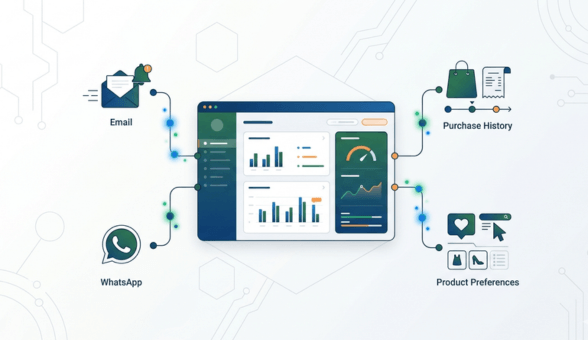
Collected data that sits unused in a spreadsheet has no value. Activation means using customer data to personalise the experience at scale. For Indian e-commerce sellers, the highest-impact activation channels are email, WhatsApp, and on-site personalisation.
Email campaigns built around purchase history consistently outperform generic broadcast messages. A customer who bought protein supplements three months ago is a clear candidate for a replenishment reminder. A customer who browsed silk sarees but did not buy is different from someone who bought three times in the last quarter. Treating them the same wastes your data and your marketing spend.
Understanding how email marketing works for Indian online stores gives you a practical foundation before layering personalisation on top of your campaigns.
| Customer Signal | Activation Trigger | Channel |
| Product viewed 3 times, not bought | Price drop or restock alert | Email or WhatsApp |
| Purchased 90 days ago | Replenishment reminder | |
| High order value, frequent buyer | Early access to new arrivals |
3. Retention: Using Data to Keep Customers Coming Back
The economics of Indian e-commerce make retention more valuable than acquisition for most brands. Acquiring a new customer costs several times more than retaining an existing one, and returning customers typically spend more per order.
A first-party data strategy pays its biggest dividends in retention. When you know a customer’s purchase history, their product preferences, and how they typically respond to offers, you can craft communications that feel relevant rather than generic. This is what separates brands that win repeat business from those that fight for every order through paid ads.
Build your first-party data strategy
Practical Data Collection Tools for Indian Sellers
You do not need enterprise-level technology to run a first-party data strategy. The tools available to Indian online sellers today are practical and affordable.
- Your order management system already holds rich purchase history data. Use it.
- WhatsApp Business API lets you send transactional and marketing messages directly, with high open rates in Indian markets
- On-site quiz tools integrate with most e-commerce platforms and feed preferences into your customer profiles
- Google Analytics 4 is built around first-party event tracking and replaces much of what cookies used to provide for traffic analysis
For brands managing large catalogues and customer segments, integrating a CRM layer that connects your Boomimart store data with your email and WhatsApp tooling creates a single view of each customer. This is worth prioritising before your store reaches a scale where manual management becomes impossible.
Privacy, Consent, and Indian Data Laws
India’s Digital Personal Data Protection Act is moving toward active enforcement. First-party data collection done right means collecting data with clear consent, explaining how it will be used, and giving customers control over their information.
This is not just a compliance requirement. It is a trust signal. Indian shoppers are becoming more aware of data privacy, and brands that handle customer information transparently build stronger long-term relationships. Your privacy policy, your cookie consent banner, and your unsubscribe flows are all part of the customer experience.
Resources from the India Internet and Mobile Association cover the current state of digital data governance in India and are worth reviewing as your data strategy matures.
Moving Away from Third-Party Dependency
The goal of a first-party data strategy is not to eliminate paid advertising. Platforms like Meta and Google will continue to be useful for discovery and new customer acquisition. The goal is to reduce your dependence on those platforms for the full customer lifecycle.
When your own customer data is strong enough to drive retention campaigns, replenishment cycles, and upsell sequences, you gain control over a significant portion of your revenue without paying per click or per impression. The brands that build this capability in 2026 will have a structural advantage in cost and resilience over those that do not.
Building a first-party data foundation for your Indian e-commerce store starts with the basics: collect better, activate consistently, and retain more of the customers you already have.