Email Marketing for Indian Online Stores: Building a List That Actually Buys

Most Indian online store owners think about email marketing the wrong way. They collect addresses, send a newsletter, get a two percent open rate, and conclude that email does not work for Indian buyers. The problem is almost never email as a channel. It is the list, the timing, and the message. Indian buyers respond to email when it is relevant, personal, and arrives at the right point in their relationship with a brand. Generic broadcast emails to a cold list will underperform everywhere, not just India.
This guide focuses on building an email list that is predisposed to buy, then using that list in a way that matches how Indian buyers actually engage with brands over time.
Lauch your store
Why Email Still Outperforms Social for Repeat Purchases
Social media reach is increasingly pay-to-play. An Instagram post from a brand account with ten thousand followers might reach eight hundred people organically on a good day. An email to a list of ten thousand subscribers reaches all of them, directly, in an inbox they check daily. The conversion rate on a well-segmented email to past customers in India consistently outperforms social advertising to cold audiences, because the relationship already exists.
Email also owns the data. When Instagram changes its algorithm or a platform restricts brand reach, your email list is unaffected. Every subscriber on your list is a buyer relationship that you own independently of any third-party platform, which makes email list building one of the highest-return long-term investments available to an Indian D2C brand.
Step 1: Build Your List at Points of Intent, Not Just the Homepage
The most common email capture mistake is placing a single popup on the homepage and calling it a list-building strategy. Homepage visitors are often the least committed people on your site. The buyers most likely to opt in are those showing active intent: viewing a product, adding to cart, completing checkout, or reading a blog post to the end.
Place your email capture at product pages with a contextual offer tied to that product category, at the cart page with an offer for first-order savings, and at the post-purchase confirmation page asking the buyer to join for early access to new products or restocks. Each of these points captures someone who has already demonstrated interest, which means your list starts with people who are already warm.
Setting this up on your store is straightforward when your platform supports contextual email capture. Boomimart includes built-in email capture tools that let you position sign-up prompts at each of these high-intent moments without needing a separate plugin or developer work.
Step 2: Give People a Reason to Join That Is Worth Their Inbox
A generic subscribe button does not build a list. An offer that matches what the buyer is already trying to do converts consistently. For Indian buyers, the offers that work best are a discount on the first order, early access to a new product launch, exclusive restocking alerts for items that sell out, and free shipping on a minimum order threshold.
| Incentive Type | Best Placement |
| First order discount (5 to 10%) | Homepage, product page, exit intent |
| Restock alert opt-in | Out-of-stock product pages |
| Early access to new arrivals | Post-purchase confirmation, homepage |
Avoid asking for too much information at the point of sign-up. Name and email is the standard, and adding a phone number field reduces conversions noticeably. You can collect phone numbers later in the relationship, after a purchase has built enough trust for a buyer to share that level of contact.
Step 3: The Three Emails Every Indian Online Store Needs Automated
Before thinking about newsletters and campaigns, set up three foundational automated sequences. These three emails alone will generate more revenue per subscriber than any broadcast campaign because they reach buyers at the exact moment when action is most likely.
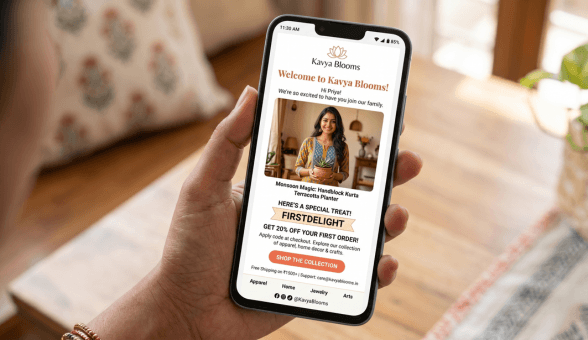
The welcome email goes out within minutes of sign-up and delivers whatever incentive you promised. It should include your brand story in two or three sentences, your best-selling products, and a clear call to action. The cart abandonment email goes out one to two hours after a cart is abandoned and reminds the buyer of what they left behind, typically with a small nudge like free shipping or a limited-time offer. The post-purchase sequence starts after the first order ships and covers delivery confirmation, a usage or care guide relevant to the product, and a request for a review after delivery. Platforms that support these automations natively, like Boomimart’s CRM integrations, save you the cost of a separate email tool for most of your list size.
Step 4: Segment Your List Before You Send a Campaign
Sending the same email to every subscriber on your list is the fastest way to increase unsubscribes and decrease engagement. The minimum segmentation every Indian online store should implement is separating buyers from non-buyers, and separating recent buyers from lapsed buyers.
| Segment | Message Approach |
| Non-buyers (signed up, never ordered) | Educational content, bestseller showcase, incentive reminder |
| Recent buyers (last 60 days) | Related products, care tips, review request |
| Lapsed buyers (90+ days inactive) | We miss you message, win-back offer, new arrivals |
Even this basic three-segment structure will outperform a single broadcast to your entire list, because each group receives messaging that is appropriate to where they are in their relationship with your brand.
Step 5: When and How Often to Send in India
Timing and frequency are the two variables most Indian store owners get wrong. For B2C email in India, Tuesday through Thursday between 10 AM and 12 PM and again between 6 PM and 8 PM are the best-performing windows, based on consistent patterns across multiple Indian e-commerce categories. Weekends work well for food, lifestyle, and gifting categories specifically, because purchase intent rises when buyers are not at work.
Frequency should be no more than two to three emails per week for active campaigns, and one email per week is sufficient for most stores in the non-campaign periods between product launches and sales. Sending more than three emails per week to non-buyers damages your deliverability and increases unsubscribe rates without a proportional lift in revenue.
For a data-backed understanding of what email benchmarks look like across Indian e-commerce categories, Mailchimp’s email marketing benchmarks report provides open rate, click rate, and unsubscribe rate comparisons across retail and e-commerce verticals that give you a realistic baseline for measuring your own list’s performance.
Building an email list that buys is not about volume. It is about collecting addresses from people who are already interested, treating their inbox with respect, and sending them things they actually want to read and act on. A list of three thousand engaged subscribers will consistently outperform a list of thirty thousand people who never asked to hear from you.