AI Product Recommendations: Do They Actually Lift Conversion

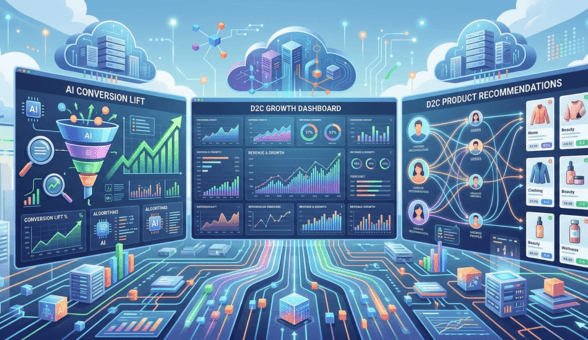
Every ecommerce platform now offers some flavour of AI-driven recommendations, from “customers also bought” widgets to fully personalised homepage layouts, but D2C brands considering the investment deserve a straighter answer than vendor marketing usually gives on whether ai product recommendations conversion gains are real or overstated. This piece looks at where recommendation engines genuinely move the needle and where the impact is smaller than commonly claimed.
Where Recommendation Engines Actually Perform Well
A recommendation engine ecommerce brands see the clearest returns from is typically on product and cart pages, where a shopper has already shown intent and a relevant suggestion feels like a natural extension of what they are already looking at, rather than an interruption. Cross-sell suggestions on product pages and complementary item prompts at cart tend to lift average order value more reliably than they lift overall conversion rate, which is an important distinction brands often blur together when evaluating results.
Recommendations also perform noticeably better for brands with a genuinely large and varied catalogue, since the engine has more meaningful signal to work with. A brand with a small, tightly curated product range sees far less benefit, since there is simply less room for a recommendation to surface something the shopper was not already going to see anyway.
Where the Impact Is Smaller Than Advertised
Ai personalization impact sales claims often get generalised from case studies involving very large catalogues, high traffic volumes, and mature data pipelines, none of which describe most growing D2C brands accurately. On a newer store with limited purchase history, recommendation engines have far less data to learn from, and generic “trending now” or “popular items” fallbacks, which is what most engines default to without sufficient data, add only marginal value over a simple manually curated bestseller section.
Homepage-level personalisation, as opposed to product and cart page recommendations, also tends to show weaker measurable impact in practice, since first-time visitors, who make up a large share of most D2C traffic, have no browsing history for the engine to personalise against in the first place.
| Placement | Typical Impact | Best Suited For |
| Product page cross-sell | Strong lift on order value | Catalogues with related items |
| Cart page suggestions | Moderate lift on order value | Most D2C stores |
| Homepage personalisation | Weaker, needs return visitors | Larger, high-traffic stores |
"Request your free demo"
Product Recommendation Best Practices Worth Following
Regardless of engine sophistication, a few practical habits consistently improve results. Limiting recommendations to three or four items rather than a long scrollable row avoids overwhelming shoppers and keeps the suggestions feeling curated rather than generic. Excluding items the shopper has already purchased recently, and refreshing the recommendation logic periodically as new products and purchase data come in, both keep suggestions relevant rather than stale.
Testing recommendation placement with a genuine A/B test, rather than assuming a widget is working simply because it is present on the page, is the only reliable way to confirm whether it is actually contributing to conversion or simply adding visual clutter that shoppers scroll past.
Deciding Whether It Is Worth the Investment for Your Store
For growing D2C brands with a modest catalogue and moderate traffic, starting with simpler, rule-based cross-sell logic on product and cart pages, rather than a fully AI-driven engine from day one, often delivers most of the practical benefit at a fraction of the cost and complexity. As catalogue size and traffic grow, and enough purchase data accumulates, a genuine machine learning-driven recommendation engine starts to justify its cost more clearly.
You can explore how Boomimart supports both simpler rule-based cross-sell setups and more advanced recommendation logic at different growth stages on the Boomimart pricing page, which breaks down what is available at each tier for growing D2C brands.