Payment Gateway Downtime: How to Build Redundancy Into Checkout

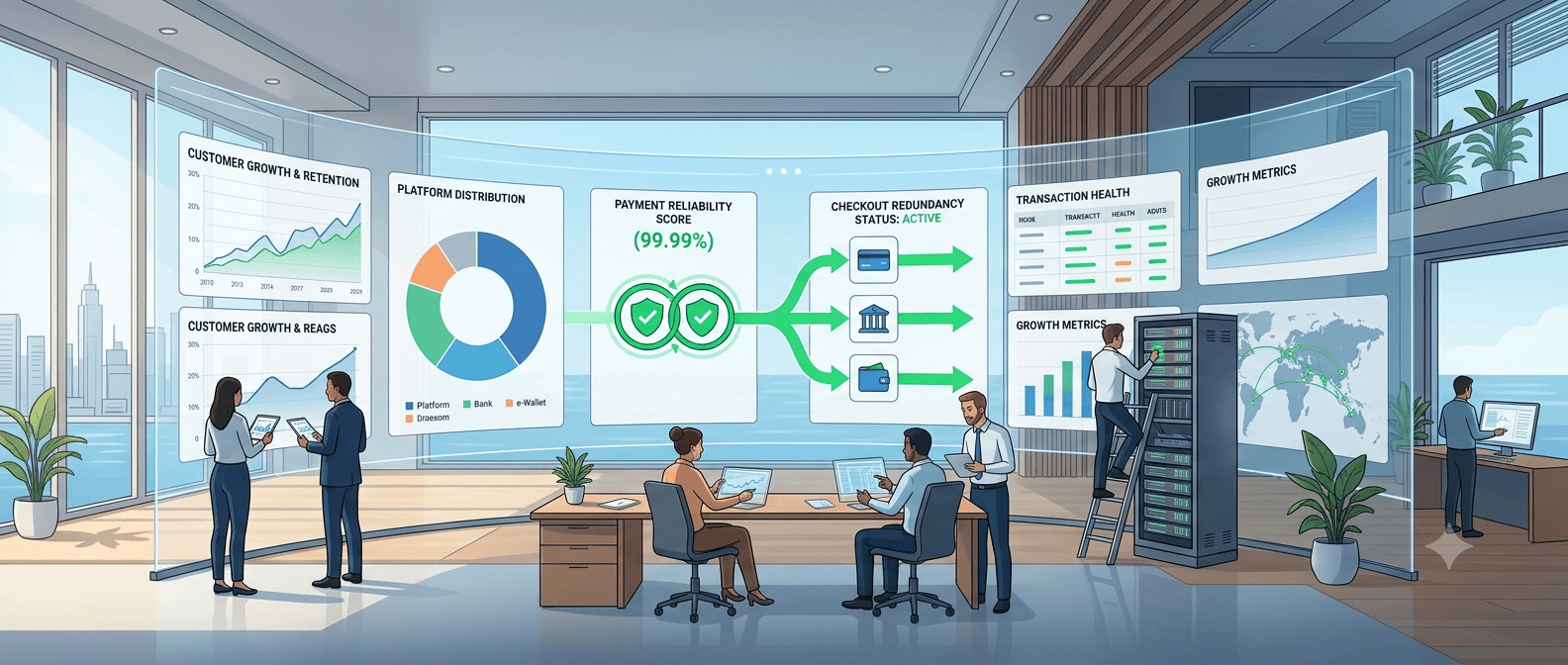
A payment gateway outage during a normal Tuesday afternoon is an inconvenience. The same outage during a festive sale event can cost a growing D2C brand a meaningful share of a quarter’s revenue in a single afternoon, since customers who hit a failed checkout rarely come back to try again later. Building redundancy into checkout is not just an enterprise level concern anymore. Even smaller D2C brands can set up a reasonable fallback without a heavy engineering lift.
Understand Why Gateway Downtime Happens
Payment gateways experience downtime for a range of reasons: scheduled maintenance windows, unexpected server issues on the provider’s side, network routing problems, or in rarer cases a coordinated attack against the gateway itself. Some of these are predictable and can be planned around, while others arrive without warning, which is exactly why a single point of failure in checkout is a genuine business risk rather than a theoretical one.
The Case for a Secondary Payment Gateway
The most direct way to build redundancy is integrating a second payment gateway as a fallback, configured to activate automatically or with minimal manual intervention when the primary gateway fails a health check. This does add integration and maintenance overhead, since two gateways mean two sets of API credentials, two reconciliation processes, and two support relationships to manage. For brands doing meaningful transaction volume, that overhead is generally worth the protection against a checkout that goes completely dark during an outage.
Health Checks That Actually Catch Problems Early
A redundancy setup is only as good as its ability to detect a problem quickly. Automated health checks that periodically test the primary gateway’s response time and success rate, rather than waiting for customer complaints to surface an issue, catch degraded performance well before a full outage. Setting a clear threshold, such as a spike in failed transactions within a short window, for when to automatically route new transactions to the backup gateway removes the need for a person to notice and react manually during a live incident.
Vendor Selection Criteria Beyond Uptime Guarantees
When evaluating a secondary gateway, uptime percentage alone does not tell the full story, since two providers can both advertise similar uptime figures while differing significantly in how quickly they communicate during an actual incident. Ask prospective secondary providers about their incident communication process, their historical response time during past outages, and whether they offer a status page with real time updates, since these operational details matter more in practice than the headline uptime number on a sales page.
See Our Payment Redundancy Setup
Communicate Clearly When Checkout Is Degraded
Even with a solid fallback in place, some downtime is unavoidable, and how a store communicates during that window matters almost as much as the technical fix. A clear, honest message on the checkout page explaining that payments are temporarily delayed, along with an alternative contact method for urgent orders, keeps customer trust intact far better than a generic error page or a checkout that simply stops responding without explanation.
The table below compares the main redundancy approaches available to growing D2C brands.
| Approach | What It Involves | Best Suited For |
| Secondary gateway failover | Automatic switch to a backup provider on failure | Brands with meaningful transaction volume |
| Manual fallback link | A backup payment link shared during outages | Smaller stores with lower transaction volume |
| Queued retry system | Holding failed transactions for automatic retry | Stores where a short delay is acceptable |
Choosing Between Automatic and Manual Failover
Fully automatic failover offers the fastest recovery but requires more upfront engineering and testing to get right, while a manual failover process, where a team member triggers the switch after confirming an outage, is simpler to build but slower to respond during an actual incident. Many growing brands start with a manual process and graduate to automatic failover once transaction volume makes the response time gap too costly to accept, which is a reasonable staged approach rather than an all or nothing decision.
Reconciliation Gets More Complex With Redundancy
Running two payment gateways means accounting and finance teams now need to reconcile transactions across two separate settlement reports rather than one. This is manageable with the right process, typically a shared transaction ID mapped across both gateways and a clear rule for which gateway processed which order, but it is worth planning this reconciliation workflow before the redundancy setup goes live rather than discovering the gap during month end closing.
Test the Failover Before You Need It
A redundancy system that has never actually been tested under real conditions is a plan on paper rather than a working safeguard. Running a scheduled test, ideally during a low traffic window, where the primary gateway is intentionally taken offline to confirm the fallback activates correctly and orders continue processing, catches configuration issues long before a real outage puts them under pressure. Many teams that skip this step discover their fallback has a broken configuration only during an actual incident, which defeats the purpose of building redundancy in the first place.
Planning Redundancy Costs Into Growth Projections
As a D2C brand scales, transaction volume and the resulting cost of downtime both grow together, which means the case for investing in redundancy tends to strengthen over time rather than staying constant. Brands that build a basic manual fallback early, then upgrade to full automated failover once volume justifies the added engineering cost, generally spend less overall than those who either over invest too early or wait until a costly outage forces the decision under pressure.
Weigh the Cost Against Your Actual Risk Exposure
Building full gateway redundancy is not free, both in integration effort and ongoing reconciliation overhead, so it is worth being honest about actual risk exposure before committing engineering time to it. A store doing a handful of orders a day during off peak periods may be better served by a simple manual fallback link, while a brand doing significant volume during festive sale windows has a much stronger case for full automated failover, since the cost of an hour of downtime scales directly with order volume.
Boomimart’s pricing page outlines the payment gateway options available out of the box for stores built on the platform, and brands wanting a closer look at how failover is configured can request a demo to see the setup walked through directly.
For a broader industry perspective on payment reliability standards, the PCI Security Standards Council publishes guidance that is worth cross referencing when evaluating any secondary payment provider for a production checkout.