Website Speed and Sales: The Real Cost of a Slow Storefront

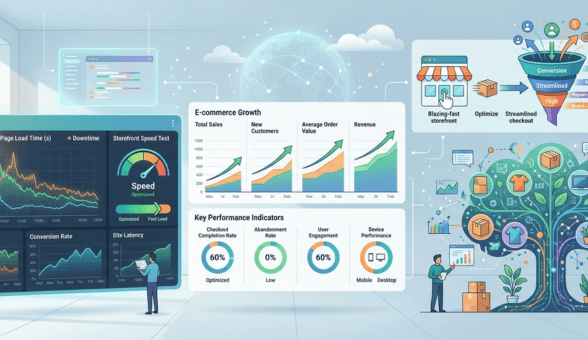
Website speed and sales impact is one of those relationships founders intuitively understand but rarely quantify, until a slow storefront is already costing meaningful revenue every single day it goes unaddressed. This guide puts real numbers behind page load time conversion rate research and explains why treating speed as a technical afterthought is one of the more expensive mistakes a growing D2C brand can make.
What the Data Actually Shows
Multiple large-scale studies across ecommerce platforms consistently show a clear pattern: conversion rate drops noticeably as page load time increases past roughly two to three seconds, with the steepest drop-off typically occurring once load time crosses the three to five second mark. This is not a minor, marginal effect either, since even a one-second delay in load time has been shown in various industry studies to meaningfully reduce conversion, particularly on mobile devices where users have less patience and often less reliable network conditions than on desktop.
Bounce rate follows a similarly steep pattern, with visitors abandoning a slow-loading page before it even fully renders far more often than most founders initially assume when reviewing their own site’s analytics data.
Slow Website Cost Ecommerce Businesses Directly
The slow website cost ecommerce brands absorb is not limited to lost conversions on that single visit either. A slow, frustrating experience also affects return visit likelihood and brand perception, since customers who had a poor experience once are less likely to return for a repeat purchase, compounding the immediate lost sale with a longer-term reduction in customer lifetime value that rarely shows up directly in a simple conversion rate metric alone.
Paid advertising efficiency takes a hit too, since driving traffic to a slow-loading landing page or product page effectively wastes a portion of every advertising rupee spent, as a share of that paid traffic bounces before ever reaching the point of conversion the campaign was designed to drive.
| Load Time | Typical Impact on Conversion | Typical Impact on Bounce Rate |
| Under 2 seconds | Baseline, strongest performance | Lowest bounce rate |
| 2 to 3 seconds | Moderate decline begins | Noticeable increase |
| Over 5 seconds | Steep drop-off | High bounce, significant loss |
"Get your free speed audit"
Speed Optimization Sales Impact: Where to Focus First
For most D2C storefronts, the highest-impact speed optimization sales impact opportunities tend to come from image optimisation, since unoptimised, oversized product photos are consistently one of the largest contributors to slow page load across ecommerce sites specifically. Reducing third-party script bloat, things like excessive tracking pixels, chat widgets, and marketing tools loaded on every page regardless of necessity, is another common quick win that often gets overlooked since these scripts are added incrementally over time by different teams without anyone auditing their cumulative performance cost.
Server response time and hosting quality also matter more than many founders initially assume, since even a perfectly optimised frontend cannot fully compensate for a slow backend or an undersized hosting plan struggling under genuine traffic load.
Making Speed a Continuous Priority, Not a One-Time Fix
Page speed tends to degrade gradually over time as new features, tracking scripts, and content get added to a site without anyone actively monitoring the cumulative performance cost of each individual addition. Treating speed monitoring as an ongoing practice, rather than a one-time project completed and then forgotten, prevents the slow, incremental decline that eventually erodes conversion rates without an obvious single cause to point to.
You can see how Boomimart approaches storefront performance as part of its broader platform offering on the Boomimart pricing page, which outlines the performance-focused features available to growing D2C brands.